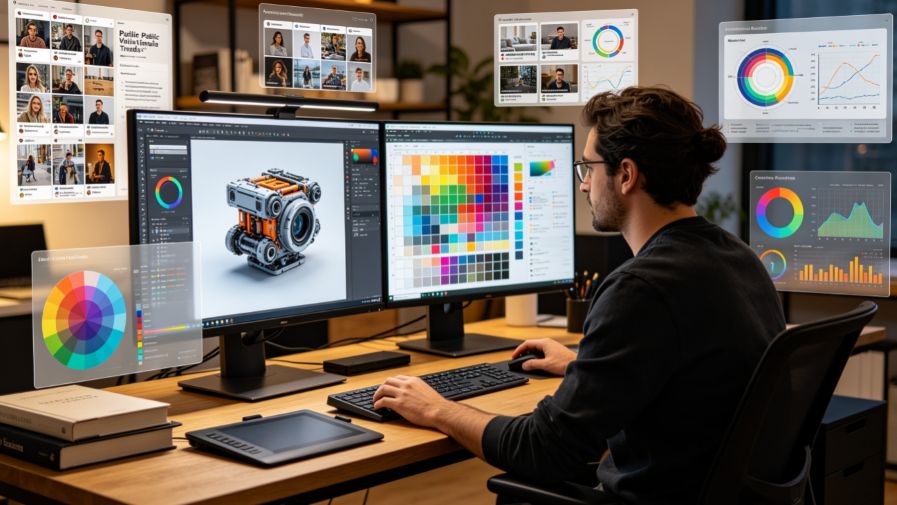
Public social media platforms generate billions of images every day, creating one of the largest collections of visual references ever assembled. Designers, illustrators, 3D artists, motion graphics specialists, and creative studios increasingly observe these publicly shared images to understand changing styles, color preferences, composition techniques, and audience interests. Research from DataReportal consistently shows that social platforms remain among the world’s most widely used digital services, making them valuable sources for identifying broad visual trends that influence creative industries.
As this growing stream of public content becomes easier to study, developers have created tools that organize large datasets for analysis. One example is a social media scraping API, which helps researchers and software developers collect publicly available information to examine large-scale visual patterns across multiple platforms. Used responsibly and within applicable platform rules, these technologies provide insights into evolving design preferences while raising important questions about originality, attribution, and ethical data use.
Creative Inspiration Has Become More Data-Informed
Artists have always learned by observing the work of others. Museums, photography books, magazines, and design galleries served this purpose long before social networks existed. Today’s difference lies in the speed and scale at which visual inspiration becomes available.
Reports from Adobe indicate that creative professionals increasingly rely on digital communities to discover emerging techniques, color palettes, typography styles, and animation methods. Rather than waiting for annual design publications, creators can observe trends almost as they develop.
This constant flow of public imagery influences many areas of computer graphics, including:
- User interface design
- 3D rendering styles
- Character illustration
- Architectural visualization
- Motion graphics
- Game environment design
- Product visualization
The result is a creative process that combines traditional artistic judgment with observation of large-scale public conversations expressed through images.
The Case for Studying Public Visual Trends
Supporters argue that analyzing public visual content allows artists to understand broader cultural movements rather than simply copying individual works. Looking at thousands of publicly shared images reveals patterns that would be difficult to recognize from isolated examples.
Studies published by MIT Media Lab have demonstrated how large image collections can reveal social behaviors, communication patterns, and cultural differences. Similar approaches can help creative teams recognize changing preferences in lighting, composition, illustration techniques, or interface design.
For example, an animation studio preparing a new project may notice increased popularity of softer color gradients across publicly shared artwork. A game developer might observe growing interest in stylized low-polygon environments. An industrial design company may discover renewed appreciation for minimal product photography.
These observations inform creative direction without dictating final artistic decisions.
The Other Side of the Debate
Despite these advantages, many artists express understandable concerns. Public visibility does not automatically mean creative work should become raw material for unrestricted analysis or imitation.
Organizations such as The Association for Computing Machinery (ACM) emphasize that responsible computing includes respecting intellectual property, privacy expectations, and ethical use of publicly accessible information. Similar principles apply when studying creative works shared online.
Critics point out that algorithms can sometimes encourage visual uniformity. When thousands of creators respond to the same trending aesthetics, originality may gradually decline. Popular styles spread rapidly, making different artists appear increasingly similar despite independent efforts.
This phenomenon creates an important tension. Data can improve awareness of trends, yet excessive reliance on trends may reduce creative diversity.
Computer Graphics Benefits From Patterns, Not Copies
The strongest argument for responsible visual analysis focuses on identifying broad patterns rather than reproducing individual pieces.
Professional graphics teams rarely seek to duplicate a single illustration or photograph. Instead, they examine aggregated characteristics such as:
- Frequently used color combinations
- Popular camera angles
- Common lighting techniques
- General composition preferences
- Emerging visual storytelling approaches
- Changes in typography styles
This distinction matters. Recognizing that warm cinematic lighting has become popular differs significantly from recreating another artist’s exact composition.
Experts at Nielsen Norman Group frequently note that identifying user preferences can improve visual communication while leaving room for original execution. Computer graphics workflows benefit most when insights guide decision-making rather than replace creativity.
Technology Can Support Better Creative Decisions
Modern graphics production already depends on sophisticated software pipelines. Teams combine digital asset management, procedural generation, rendering engines, version control, and collaborative review systems throughout production. The growing adoption of 3D product visualization in business software also demonstrates how computer graphics workflows increasingly extend beyond entertainment and creative media into enterprise applications.
Trend analysis has become another input within this broader workflow. Large datasets help answer questions such as:
- Which illustration styles receive sustained attention?
- How are visual preferences changing across different regions?
- Which animation techniques are becoming more common?
- What color combinations appear most frequently during specific seasons?
These answers provide context rather than creative instructions. Designers still evaluate whether observed patterns align with project goals, target audiences, and brand identity.
Ethics Should Remain Part of Every Workflow
Responsible analysis begins with respecting platform policies, copyright protections, and applicable laws governing publicly available data. Researchers and developers should understand the difference between observing aggregate trends and exploiting individual creators.
The World Intellectual Property Organization (WIPO) explains that copyright protects original creative expression regardless of where it is published. Public visibility does not remove ownership rights.
Similarly, findings from the OECD on trustworthy artificial intelligence highlight the importance of transparency, accountability, and respect for human rights when developing data-driven technologies. These principles extend naturally to systems that analyze public visual information.
Organizations should establish clear internal guidelines regarding attribution, dataset documentation, and responsible research practices. Creative professionals benefit when ethical standards evolve alongside technological capabilities.
Balancing Innovation With Originality
Some critics worry that widespread trend analysis could eventually produce formulaic design. Others believe it expands creative possibilities by exposing artists to ideas from cultures and industries they might never encounter otherwise.
Both perspectives contain valid points.
Historical evidence suggests artistic innovation often emerges through observation, adaptation, and reinterpretation rather than complete isolation. Renaissance painters studied earlier masters. Graphic designers learned from printed advertisements. Film directors built upon previous cinematography techniques.
Public digital platforms continue this tradition on a much larger scale. The difference is that modern software enables observation across millions of publicly shared examples instead of hundreds.
Creative success still depends on transforming inspiration into something distinct. Technical tools may reveal what people are creating, but they cannot replace imagination, experience, storytelling, or artistic judgment.
Looking Ahead
Computer graphics workflows will likely continue integrating large-scale visual analysis as software becomes more capable of organizing publicly available information. Creative professionals can benefit from understanding broad visual movements while maintaining strong ethical standards throughout the design process.
The healthiest approach combines careful observation with independent thinking. Public trend analysis should serve as a compass rather than a blueprint. Respecting creators, acknowledging intellectual property, following platform requirements, and producing genuinely original work ensure that technology strengthens creativity instead of limiting it. As visual culture continues to evolve across digital communities, responsible research and thoughtful artistic interpretation will remain the foundation of meaningful computer graphics.